Showing posts with label plants. Show all posts
Showing posts with label plants. Show all posts
Friday, March 7, 2014
Native Plant Myth 3 Native Plants are not as showy or ornamental as exotic plants
I am dedicating the last of my series on “Myths about Native Plants” to a subtle but widely held misconception. I believe that this particular misconception is the number one reason that prevents people from embracing natives more fully in designed landscapes.
Myth 3: Native plants are not as showy or ornamental as exotic plants.
It’s not that people think that native plants are ugly; rather, when it comes to choosing plants, natives are perceived to be a bit more natural, less over-the-top-bloomy than exotic garden plants. Walk into your local garden center and just try to resist the seduction of a lipstick-red Knockout Rose or the voluptuous softball-sized flowers of a Limelight Hydrangea. The native section, by comparison, is populated by a sad collection of leggy, dull perennials.
 |
| Dogtooth Violet |
When I was in graduate school, I took my girlfriend to the local botanical garden. I had just finished a class on native plants, and I wanted to show her how wonderful and unappreciated our local plants were. When we arrived, the native garden was hard to distinguish from the unmanaged woodland next to it, and the only plant blooming was a Dogtooth Violet. I got on my knees to show her how delicate and beautiful this little plant was. It was so exquisite it barely existed. She seemed unimpressed. On our way out of the garden, we passed a tulip border that was so colorful, so showy, I was convinced one could see it from the moon. She exclaimed, “Now that’s beautiful!” I knew then my cause was lost.
Since then, I have designed plantings for scores of gardens and public landscapes, particularly large scale perennial plantings. I use native plants interchangeably with exotics for incredibly showy borders and beds. The palette of native plants I use is large and knock-your-socks-off bloomy. Turn-your-head saturated with color. Va-va voom impact. In fact, natives from the American prairie are incredibly popular right now in European designed gardens. The problem is not that native plants are intrinsically less ornamental than exotics; the problem is one of design. Native gardens, for the most part, overly imitate natural plant communities. Native gardens end up looking like some poor imitation of a woodland or meadow. As a result, we have no precedent for natives in man-made landscapes.
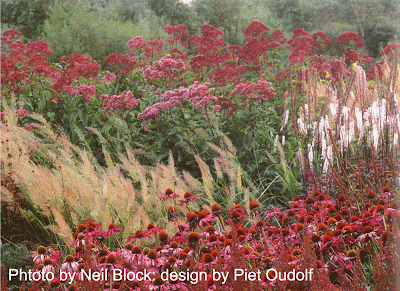 |
| A border of mostly American natives designed by Piet Oudolf; photo by Neil Block |
Listen up native plant advocates: until native plants are shown to be beautiful, they will never be fully embraced by the American public. The argument about habitat and the environment are good, but what people ultimately want in their landscapes is something pretty. What we are missing are native plant gardens dedicated to showing the ornamental beauty of native plants. Each time a new native garden imitates a natural habitat, we reinforce the notion that native plants aren’t worthy in the designed landscapes.
This is exactly why the New Native Plant Garden at The New York Botanical Garden excites me so much. The 3.5-acre garden currently under construction will showcase “the beauty and diversity of native plants and the best in contemporary garden design.” Vice President Todd Forrest created much of the vision for the garden as a “departure from the habitat-based model that has shaped the design of many public native plant gardens.” Instead, the garden will be “foremost a beautiful garden with native plants providing both seasonal spectacle and year-round structure.” NYBG has charged Oehme, van Sweden and Associates (OvS) to design the gardens. Principal Sheila Brady, project manager Hilary Oat-Judge, and others at OvS are creating a series of garden rooms to work with the site’s diverse topography, hydrology, and habitats.
The previous garden, according to Forrest, featured a series of regional ecosystems such as the New Jersey Pine Barrens, Long Island’s Hempstead Plains, and a serpentine barren. But these ecosystems became impossible to maintain at such a small scale. Forrest says, “Aggressive generalists overran their more demure counterparts, and the various habitats quickly lost their character.” What’s worse, says Forrest, is that “the garden seemed designed to preach to the choir and ignore the congregation. Native plant enthusiasts noted the presence of their favorite taxa, while the general public was left wondering exactly where the ‘garden’ was.”
The focus of the new garden is on the quality of the design, not on imitating a habitat. I had the pleasure of working on the early stages of this project at OvS. I can say with confidence: the designs for this space are outstanding. The design will, in Forrest’s words, “redefine what a native plant garden can be.” The garden will feature bold, contemporary geometry of boardwalks, bio-filtering water features, and modern plantings. The garden is slated to open in 2012. Here is a link with more information about the garden.
What is so exciting about this new garden is that it sheds the nostalgia of other native plant gardens that look backwards to some declining ecosystem. This garden looks to the future. It will be a model that shows that native plants can populate and beautify the places that need them the most: our front yards, public parks, and corporate landscapes.

Thursday, March 6, 2014
Low Maintenance Organic Landscaping Using Blueberry Plants

Introduction
You have always wanted a great looking landscape to brighten the yard. But who has time to spend every free minute caring for the yard? With some planning and a little know how it is easy to cut down on the drudgery of yard work. Having an easy care landscape means you must develop a realistic plan. Trees and shrubs give substance to a landscape and flowers provide excitement and surprise. You can enjoy the fruits of near effortless edibles including blueberries and strawberries. Blueberries are a low Maintenance plant. They have few pest and are native to North America. They require a soil pH of 4.6 to 5.1.
Take a look at your landscape
Knowing the physical characteristics of your site, the soil, climate, topography, and exposure is a vital part creating and maintaining a low Maintenance landscape. Choose well adapted Plants to design a functional, attractive layout for your yard.
Some factors like climate you have no control over and it affects your whole yard. Other factors you have some control over, Like the amount of shade which can differ widely in different parts of the yard. Growing Plants can be a breeze if you have deep, fertile soil rich in organic matter. But even if you dont (very few of us do) you can still have a productive low Maintenance yard. You can decide to improve your soil by adding organic matter or using raised beds and adjusting the soil pH if needed. You can also look for Plants that are adapted to your soils existing conditions. Raised beds can provide ideal growing conditions for a variety of vegetables, bushes, and flowers. Where the soil has poor drainage raised beds can solve that problem.
Test your soil. Your local extension service can provide a test for a sample you supply. Test results will tell you the soils fertility, pH, and organic matter content. Getting your soil in shape before planting will go a long way toward promoting healthy, trouble-free Plants in the future.
Reduce Maintenance on tough to mow slopes by replacing turf with a mixture of low care flowers and shrubs such as low growing easy Maintenance blueberry bushes and using a mowing strip. For example, North Country blueberry Plants grows 18 to 24 inches tall or North blue blueberry Plants that grows to a height of 20-30 inches could be good selections.
Lawns
Reduce mowing chores by replacing some of the lawn with shrubs, trees or ground cover. Eliminate grass growing under or along fences and walls and low branching trees. The kind of grass you grow has a lot to do with how much Maintenance it requires. There are grasses that do not grow tall and thus require minimal mowing.
For example, No mow grass ultra low Maintenance grass. Eliminate hours of lawn mowing and lawn Maintenance each month with Pearls Premium grass. Pearls Premium grows slowly above ground. Below ground, it can put down 12" roots, tapping into naturally occurring moisture and nutrients. This type of grass will reduce watering requirements and a lot of mowing. Mow only when it needs it not on a regular weekly or bi-weekly schedule.
End edging forever- For the busy person trees, shrubs and flower beds can quickly turn into a night mare. The shaggy edges that form between planting and the lawn area can give any area an unkempt look and be a real pain to trim. Mowing strips are the solution. A mowing strip is a flat band of brick or flat rock that sits flush with the soil surface and you just mow over the area eliminating the need for the hand or string trimmers to cut the grass at the edge of the of the bed. You just let one wheel ride on the strip and the other on the lawn.
Ground cover
Utilizing ground cover can help to change a bare or dull part of your yard into a beautiful, low Maintenance show area. Low growing ground cover Plants can serve you well in some areas. For example in our yard we had a rock area that we could not mow and looked ugly. We let low growing ground cover Plants grow over this area to transform it into a beautiful area that required essentially no care. You might consider RUBY CARPET a ground cover blueberry plant. The height of the ruby Carpet Plants grow to be 4 to 6 inches at maturity and spread outward to create the Red Carpet. Ruby Carpet is selected for form, color and resistance to dryer soil conditions than most blueberry Plants.
Blueberries make a beautiful delicious landscape
When planting blueberries as part of your landscape you should consider combining them with other Plants that thrive in acid soil such as azaleas, rhododendrons and camellias. The following are some example of Plants you can consider.
Legacy blueberry Plants grows 4 to 5 feet tall and can create 4 seasons of interest in your landscape. Spring brings white flowers that develop into shiny green fruit which turn bright blue in the summer. Smooth, glossy-green leaves look attractive all spring & summer in the fall they produce beautiful orange-red leaves.
Sunshine blue is a short plant that is very suitable for growing in a landscape or in containers.
Ornablue grows about 3 feet tall and is considered to be the best ornamental of its size and stature.
North Country grows 18 to 24 inches tall and is an outstanding blueberry plant for landscapes and container growing.
North blue, grows to a height of 20-30 inches. It is good for landscapes and container growing. Its large glossy, dark green leaves turn dark red in the fall making it of good ornamental value.
Patriot grows 3 to 5 feet tall and is also an excellent container and landscape variety. It is also a very good producer of fruit.
For tall hedges you want to use for privacy use the faster growing, upright varieties such as Jersey, or Ozark Blue. To make solid hedges or screens, place Plants 2½ to 3 apart.
Rabbiteyes grow tall so they can make excellent Plants for areas you want to screen off for privacy. Tifblue is considered among best rabbiteyes.
Blueberry Plants grow slowly, and grow about a half-foot a year on mature branches. The Plants are multi-stemmed with new shoots often developing from the base.
Eatable Landscaping
Recently edible Landscaping has received more attention. Part of the reason is because of the well documented health benefits and another is because of the economics of growing your own fruit and vegetables. Raised beds can provide an excellent controllable space to grow blueberry bushes and vegetables. Anyone who has eaten really fresh produce knows a food-producing garden is worth the effort. It is surprising that it hasnt caught on earlier. Its such a brilliant way of taking advantage of the little bit of land that many of us have but usually use strictly for ornamentals. Blueberries make a beautiful delicious landscape. Blueberry Plants can serve as ornamentals while also being grown as a food source.
Border plantings and along Walkways
You can plant shrubs along the borders of your property that can serve several purposes. Serve for privacy, eliminate grass growing under or along fences and the related mowing problems, serve as perimeter border to define your property boundaries while at the same time beautifying you landscape. If you use eatable bushes such as blueberry bushes you are can grow blueberries for your health and enjoyment. Ornablue blueberry plant can serve this purpose well and is considered to be the best ornamental varieties of its size and stature.
Border plantings along walkways or surrounding a planting bed can work well, choose Sunshineblue, Ornablue or Northcountry. These can be planted along with dwarf rhododendrons or compact azaleas. All three of these blueberry bushes will grow well in Kentucky. Ornablue is considered to be the best ornamental variety of its size and stature. Northcountry will grow well all the way up to growing zone 3. The Sunshine blue blueberries we planted on our properties in Kentucky and Tennessee have turned out to be pretty much evergreen bushes the year around. Rhododendrons and azaleas can be planted along with blueberry Plants to blend into borders or serve as a prickly hedge.
Choosing Blueberry Plants to grow
Purchase your Plants state-inspected reliable nursery. Bare root Plants are usually sold by most nurseries unless you pick the Plants up at the nursery. you obtain Plants to be planted in the spring or fall. What is important is to plant them when theyre dormant, either well before or well after they start new growth of leaves, blossoms and berries.
Usually two-year-old potted or bare-root Plants are sold by nurseries and are your best purchase. Older Plants may give you a harvest sooner, but they are generally not cost-effective because of their added expense and can be harder to establish. Younger Plants need to be grown under nursery conditions before they can be planted in the field.
Harold Stewart understands both the theory and practical applications of growing blueberries. He has a PhD in biophysics with many years of teaching, extensive hands on and research experience at the university level. He spent his growing up years on a farm growing crops and raising animals. His farm and nursery (Blueberry Croft Farm and Nursery) specializes in naturally grown blueberries without using harsh pesticides. The farm is a reputable source for quality blueberry Plants. He grows over 30 varieties of blueberries and sells northern, southern and rabbiteye varieties of blueberry Plants all over the in the lower 48 continental United States. The farm is in growing zone 6 in an Amish community with "green thumb" Amish employees in southern Kentucky. Because of his expertise he has served as a United States expert representative to the World Health Organization for committee work. He can be reached at http://www.blueberrycroft.com/. Get free S/H on orders of $65+.
Article Source: http://EzineArticles.com/?expert=Harold_Stewart
Subscribe to:
Posts (Atom)